
You know exactly how much is normal.
Because you have been paying attention for months.
You know the difference between a heavy shed day and what the drain looks like now.
You used to wash your hair every other day without thinking about it.
Now you go four or five days between washes. Because washing it means losing it. And you would rather not.
You have probably pulled it out of the drain and held it.
You may have put it in a tissue and kept it. Not because you wanted to — but because you knew that if you ever needed to show someone, a GP or a specialist, you would need evidence.
The GP told you your bloods were normal. Or it was normal for your age. Or it happens to a lot of women.
None of which explained the drain.
Here is what is actually happening — and what can still be done about it.
 Before
 After — 20 weeks
Helen M., 47 · Edinburgh · Daily shedding · bloom peptide hair+scalp serum · 20 weeks
The thing about tracking it — the counting, the saving, the knowing — is that it is entirely private.
Nobody else in your household is paying attention to the drain the way you are.
Nobody else knows you stopped washing your hair every other day.
You are the only one keeping the record.
There is a particular kind of loneliness in managing something nobody around you can see.
The drain looks like a drain. You look, to everyone who knows you, essentially the same as always — because you know your hair, you know your products, you know which days are better.
What you are carrying underneath that management is something else entirely.
A dread, before wash days, that is small enough to function around but present enough to be exhausting.
You have not told anyone you count it. Most women who do this have not told anyone they count it.
What is worth understanding is what changed in the follicle — and whether the cascade that produced this can still be interrupted.
It is not one problem. It is three problems running at the same time.
This is why the standard treatments produce partial results.
Each of them addresses one part of the cascade. The other two parts continue unchecked.
 Before
 After — 20 weeks
Karen L., 52 · Manchester · Shedding reduced · 20 weeks
Problem 1: DHT sensitivity at the follicle
Oestrogen protects hair follicles. It keeps them resistant to DHT — the androgen that triggers miniaturisation.
When oestrogen falls in perimenopause, that protection falls with it.
DHT starts binding more readily to receptors in the follicle’s dermal papilla. Each growth cycle produces a slightly finer, slightly shorter hair. Over months and years, this compounds.
The follicle is not dead. It has been suppressed. This distinction is what determines what is still possible.
Problem 2: Microcirculation changes at the scalp
Oestrogen also maintains blood vessel tone in the scalp.
As levels fall, scalp microcirculation decreases. The follicle receives less nutrient and oxygen delivery with each cycle.
A follicle that was receiving everything it needed at 40 is receiving measurably less at 48. Even in women eating well. Even in women otherwise healthy.
 Before
 After — 20 weeks
Diane R., 49 · Dublin · Crown density · 20 weeks
Problem 3: Growth-phase dysregulation
The hair follicle cycles between growth (anagen) and rest (telogen).
The hormonal shift shortens the anagen phase and lengthens telogen. More follicles rest at any given time. More hairs fall out at once. The hair that grows back comes back thinner.
The three problems amplify each other. DHT sensitivity increases resting phase length. Poor circulation reduces the signal quality that restarts growth. And follicles in extended rest become harder to re-activate over time.
The critical window
Follicles in rest are not gone. They can still be signalled.
But the window is real. A follicle that has been suppressed for 18 months is harder to reach than one suppressed for 6 months. A follicle that has fully miniaturised over years may not recover.
This is why the research consistently shows better outcomes in women who address the cascade early — while the follicle is suppressed but still viable.
 Before
 After — 20 weeks
Siobhán F., 54 · Cork · 20 weeks
The treatments that fail for this kind of hair loss
Most products address one part of the problem.
Perimenopause-driven hair loss has three parts. That’s why most products produce partial results at best — and no result at worst.
Here is what the research says about the most commonly tried approaches:
Biotin supplements
Misses the mechanism
Biotin helps if you have a biotin deficiency. Most women with perimenopausal hair loss don’t. Biotin does nothing for DHT sensitivity, scalp circulation, or growth-phase signalling. Nail improvement doesn’t mean it’s helping the follicle.
Viviscal, Hairburst, Nourkrin
Addresses downstream, not upstream
Marine protein complexes. Better than biotin. They provide structural building blocks for hair, but they don’t address the follicle signalling cascade. Good for hair quality. Insufficient for follicle-level thinning driven by hormone change.
Minoxidil (Regaine)
One mechanism, permanent commitment
A vasodilator. It improves scalp blood flow — one of the three cascade points. It doesn’t address DHT sensitivity or growth-phase signalling. And stopping it causes a rebound shed that can be worse than the original loss.
DHT-blocking shampoos
Washed away in 90 seconds
Contact time is too short to penetrate to the follicle. You are paying for the illusion of addressing DHT. A shampoo cannot change what is happening in the dermal papilla. The active leaves before it can act.
Hair growth serums (single peptide)
Right idea, incomplete formula
Copper peptide serums, or single-signal peptide products, address one point in the cascade. They work — partially. The research on combination approaches consistently outperforms single-peptide results, particularly for hormone-driven thinning.
HRT alone
Necessary but not sufficient
HRT restores oestrogen, which has a protective effect on follicles. It doesn’t directly block DHT. It doesn’t address microcirculation. And the follicles that shifted into rest before HRT started may stay there — HRT gives them permission to wake up, not the signal to do it.
The conclusion from the research is not that these treatments are useless. It is that none of them addresses all three cascade points simultaneously.
Which is precisely what the six-peptide formulation does — and why the research on combination approaches is considerably more compelling than any single-mechanism study.



Her Science × Cuivre · the formulation described in this article
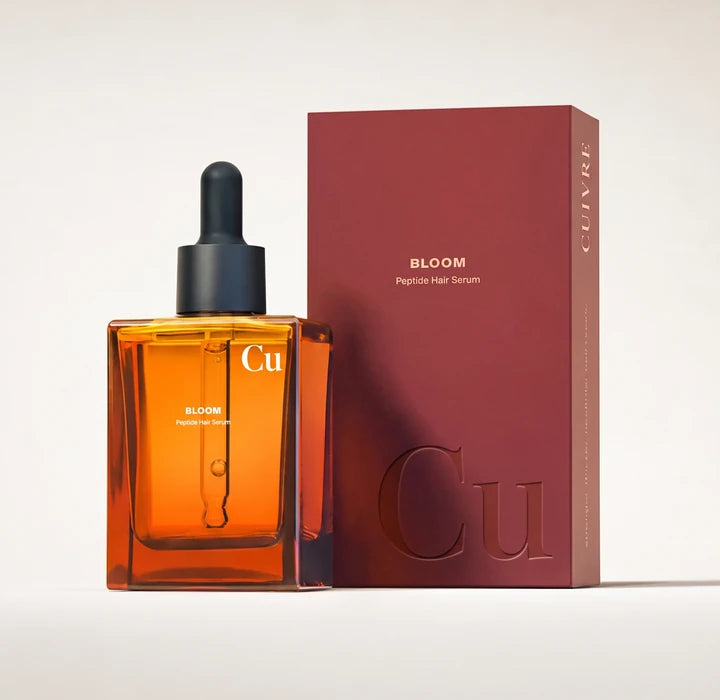
bloom peptide hair+scalp serum
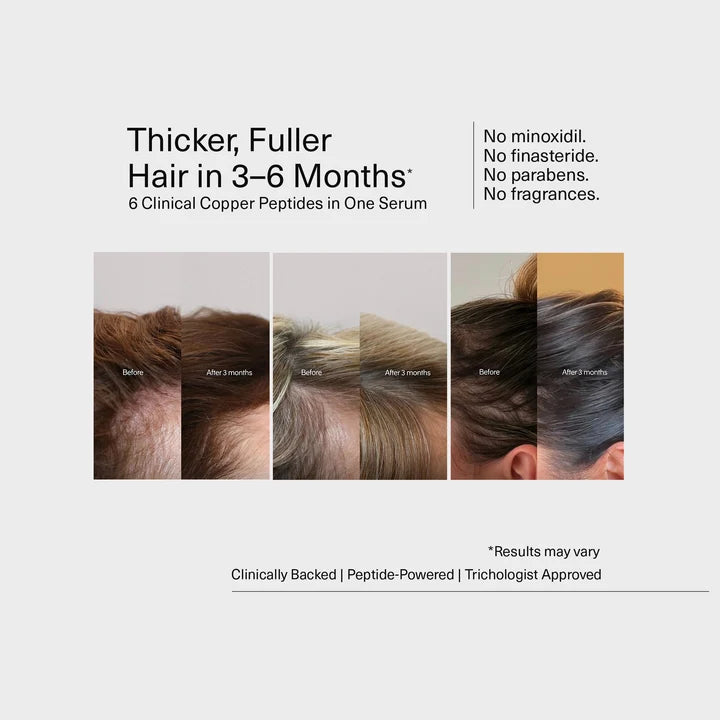
Cuivre’s advanced multi-peptide serum targets follicles to promote thicker, stronger, healthier-looking hair.
With ingredients clinically studied to:
- Reactivate biological pathways associated with healthy hair growth*
- Support visibly thicker, denser-looking hair over time*
- Reduce the appearance of shedding with consistent use*
- Improve overall scalp health and resilience*
Reader code MIDLIFE10 — 10% off your first order, applied automatically at checkout.
This batch is 500 units. When it’s gone, the next run is 6–8 weeks out.
Free delivery · 30-day scalp guarantee · 120-day density guarantee · cancel any time




What Cuivre contains — and why each ingredient is there
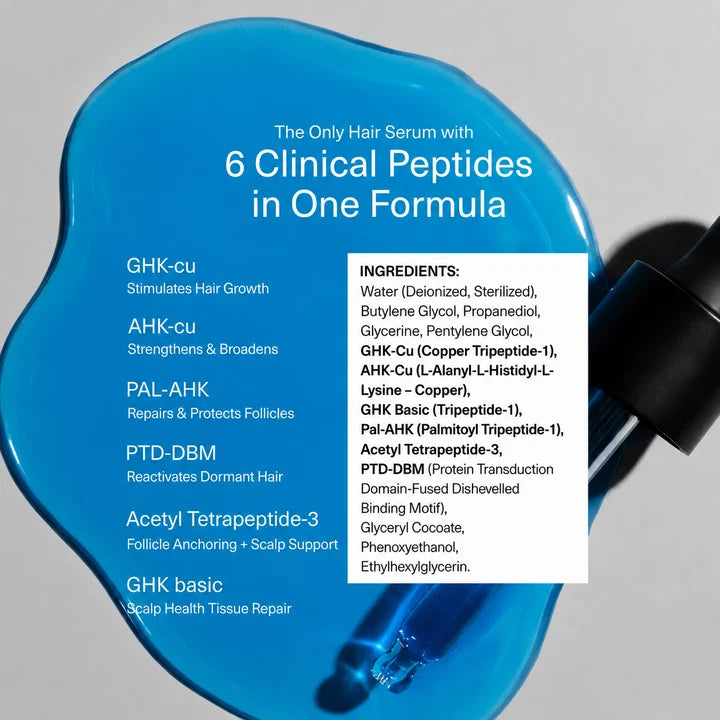
The six peptides in Cuivre are not a proprietary blend with a marketing name.
Each one was selected because it addresses a specific, documented failure point in the perimenopause hair loss cascade.
No filler. No carrier ingredient dressed up as active. Six actives. Six mechanisms.
Biotinoyl Tripeptide-1
Biotinoyl tripeptide-1 (signal peptide)
Stimulates keratinocyte differentiation and upregulates the expression of laminin — the protein anchoring the follicle to its dermis matrix. Clinical studies show 121% increase in anchoring strength. The follicle that isn’t held properly sheds prematurely.
Copper Tripeptide-1
GHK-Cu (regenerative peptide)
Increases follicle size and the proportion of follicles in active growth phase. Reduces DHT sensitivity at the receptor level. Stimulates collagen and blood vessel formation in the scalp. One of the most-studied peptides in follicle biology — addresses all three cascade points to some degree, which is why it’s the anchor of the formula.
Acetyl Tetrapeptide-3
Acetyl tetrapeptide-3 (extracellular matrix peptide)
Stimulates the ECM proteins that create the structural scaffolding around the follicle. In combination with red clover extract, clinical research shows 46% reduction in hair loss and 13% increase in hair density. This is the anti-DHT-sensitivity arm of the formula.
Myristoyl Pentapeptide-17
Myristoyl pentapeptide-17 (keratin synthesis)
Upregulates keratin gene expression in the hair shaft. Where the other peptides address the follicle’s survival and activity, this one addresses the quality of the hair it produces — thickness, tensile strength, resistance to breakage. The hair that grows back grows back stronger.
Oligopeptide-54
Oligopeptide-54 (growth factor mimic)
A synthetic growth factor that mimics the action of KGF (keratinocyte growth factor) — the molecule responsible for extending the anagen (growth) phase. Directly addresses the shortened growth cycle that is the third cascade point. More follicles in growth, for longer, each cycle.
Hexapeptide-11
Hexapeptide-11 (follicle protein)
Derived from yeast protein, this peptide improves the mechanical strength of the hair fibre and the scalp’s structural integrity. Works synergistically with Oligopeptide-54 to maintain the growth environment that the other five peptides have worked to restore.
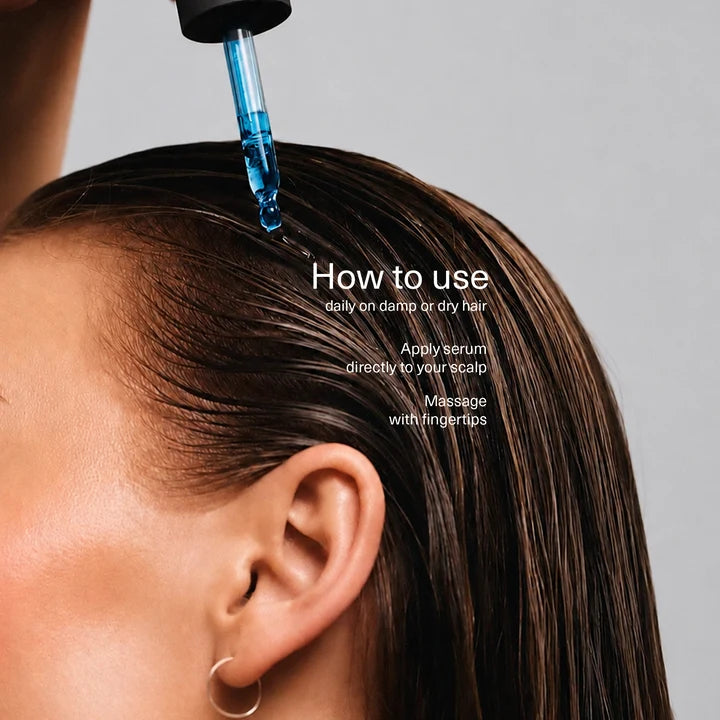
The formula is applied to a dry or towel-dry scalp and left on. It is not rinsed away. The peptides remain in contact with the follicle for hours — long enough to penetrate and signal.
This is the delivery problem that makes shampoo-based approaches physiologically impossible to work at a follicle level. Contact time is not a minor consideration. It is the mechanism.
The realistic timeline
Hair biology is slow. The growth cycle is 84 days. No product changes that.
What changes, if the signal reaches the follicle, is what happens inside that cycle.
The scalp changes first
Most users notice a change in scalp quality before they see any hair change. Less tightness. Less tenderness on manipulation. A different feel at the root. This is the anti-inflammatory component beginning to act. It is not visible — it is tactile. And it is the first signal that the cascade is being interrupted.
Day 30 guarantee: scalp change or full refundThe shed slows
As follicles begin transitioning back toward anagen, the number in telogen (rest/shed phase) decreases. The drain changes. Not dramatically — not a morning-to-morning reversal. But measurably, over the course of weeks five to eight, there is less in it than there was. Users who have been counting know the difference.
New growth appears
Follicles re-entering anagen begin producing new hair. It is short — the hair cycle does not jump forward. The new growth appears as short, fine strands, most visible at the hairline and parting. At week twelve, most users can see or feel a change in density at the affected area.
Density becomes visible
The new growth reaches length. The parting narrows. The ponytail changes diameter. The wet hair, in the mirror, shows what the dry hair has been concealing — more strands, better coverage. This is the window where the photographs taken at the start of the protocol show what has actually changed.
Day 120 guarantee: visible density change or full refund
Before
After — 20 weeks
Helen M., 47 · Edinburgh · Daily shedding · bloom peptide hair+scalp serum · 20 weeks
Her Science × Cuivre · the formulation described in this article
bloom peptide hair+scalp serum
Cuivre’s advanced multi-peptide serum targets follicles to promote thicker, stronger, healthier-looking hair.
With ingredients clinically studied to:
- Reactivate biological pathways associated with healthy hair growth*
- Support visibly thicker, denser-looking hair over time*
- Reduce the appearance of shedding with consistent use*
- Improve overall scalp health and resilience*
Reader code MIDLIFE10 — 10% off your first order, applied automatically at checkout.
This batch is 500 units. When it’s gone, the next run is 6–8 weeks out.
Free delivery · 30-day scalp guarantee · 120-day density guarantee · cancel any time
You have two choices now.
🚫 Path 1 — Do nothing
Come back to this article in six months. The follicles in rest now will have spent six more months there. The window in which they can still be signalled is real — but it is not infinite. Follicles suppressed for two years are harder to reach than follicles suppressed for six months. Fully miniaturised follicles may not recover at all.
✅ Path 2 — Try Cuivre at zero risk
30 days to notice a change in the scalp — or a full refund. 120 days to see a visible density change — or a full refund. The guarantee is specific because the mechanism is specific. You are not buying hope. You are testing a biological intervention against guarantees that reflect what the research says is achievable.
What the drain looks like on the other side of this
There is not a morning where it goes to zero.
That is not what the biology promises.
What changes is the amount.
Around weeks six to eight, something shifts.
The cycle that was producing too many shed hairs begins to correct. The anagen phase that had shortened starts to extend again.
You notice it the way you notice a cold going away.
Not with a specific moment of recovery. But with a particular morning when the drain has noticeably, undeniably less in it than last month.
And then the morning after that. And the one after that.
At some point — and this is the quietest thing — you wash your hair two days in a row without calculating whether you can afford to.
Not because you decided to. Because you just did it. Without thinking.
That is what the biology, when it shifts, actually looks like. Not dramatic. Just the absence of the thing you had gotten so used to managing.
Her Science × Cuivre · the formulation described in this article
bloom peptide hair+scalp serum
Cuivre’s advanced multi-peptide serum targets follicles to promote thicker, stronger, healthier-looking hair.
With ingredients clinically studied to:
- Reactivate biological pathways associated with healthy hair growth*
- Support visibly thicker, denser-looking hair over time*
- Reduce the appearance of shedding with consistent use*
- Improve overall scalp health and resilience*
Reader code MIDLIFE10 — 10% off your first order, applied automatically at checkout.
This batch is 500 units. When it’s gone, the next run is 6–8 weeks out.
Free delivery · 30-day scalp guarantee · 120-day density guarantee · cancel any time
Common questions
How long before I see a result?
The scalp change — less tightness, different quality at the root — typically within two weeks. The shed reduction is usually measurable by weeks six to eight. Visible density change appears between weeks twelve and twenty, depending on how long the follicles have been suppressed and how severely.
The 30-day guarantee covers the first milestone. The 120-day guarantee covers the second. We built them around the biology, not around a marketing claim.
What if I’m already on HRT?
HRT and Cuivre address different parts of the cascade. HRT restores oestrogen protection — which helps. It does not directly address DHT sensitivity at the follicle, scalp microcirculation, or growth-phase dysregulation. Cuivre addresses all three. Most users on HRT see results. Users on HRT who have been waiting for the HRT to fix the hair and it hasn’t — Cuivre is specifically for this situation.
How do I use it?
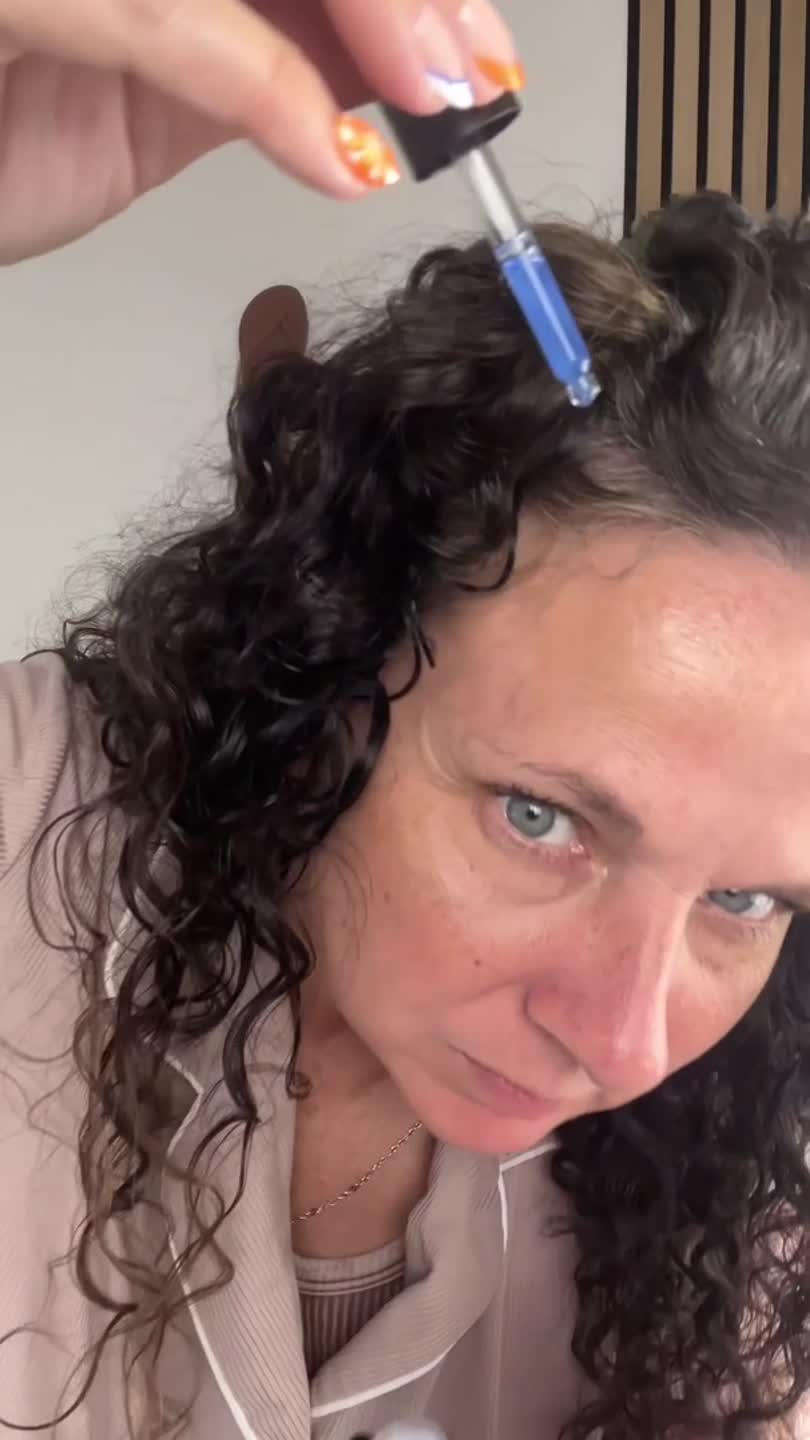
Apply to dry or towel-dry scalp, section by section, and massage in gently. Leave on — do not rinse. Use daily for the first twelve weeks, then every other day for maintenance. The leave-on application is not optional. Contact time with the follicle is the delivery mechanism. Rinsing it off negates the penetration.
Is there a reader discount?
Yes — MIDLIFE10 takes 10% off your first order. It is applied automatically when you check out through this page, so there is nothing to type in. It works on a one-time purchase or on the first payment of either plan; after that the plan bills at its normal rate. Only one code can be used per order, and it is limited to one use per customer.
The plan saving is separate and permanent: monthly delivery is 30% below the one-time price and the annual plan is 42% below it. Both can be cancelled at any time.
Tell me about the guarantees.
30-day guarantee: if you do not notice a change in scalp quality — less tightness, different feel at the root — within 30 days, email us for a full refund. No questions asked.
120-day guarantee: if you do not see a visible change in hair density by day 120, email us for a full refund. You do not need to return the product. We ask for a brief description of your experience so we can improve the protocol for future customers.
ⓘ This article is published by Her Science (herscience.co.uk), an editorial health publication. This article contains affiliate links to Cuivre scalp serum. Her Science receives a commission if you purchase through those links.
The information in this article is provided for educational purposes. It is not a substitute for medical advice. If you are experiencing hair loss, consult your GP or a qualified trichologist. Cuivre is a cosmetic product and is not intended to diagnose, treat, cure, or prevent any medical condition.
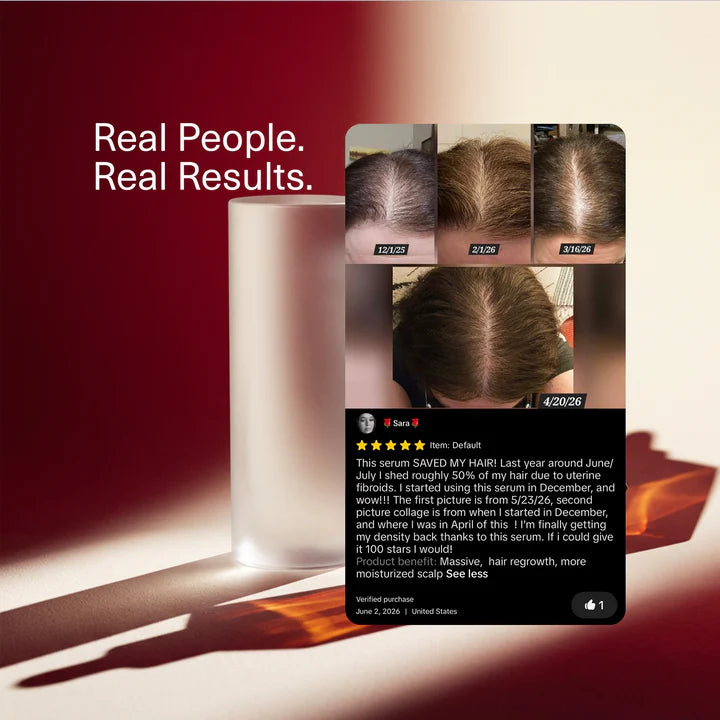
Results shown are from real customers. Individual results vary. The 30-day and 120-day guarantees are offered by Cuivre and processed through herscience.co.uk.
Sorcha P.
Age 48 · GLP-1 / weight-loss jabs
Cards on the table, six months in. I’d been hiding the crown all year thanks to mounjaro since spring brought shower handfuls, but the previous serum hid, not helped in the end. On holiday my hair went centre-parted, braver - and nobody saw scalp. Backup bottle bought without debate because empties are the honest review.
Morag S.
Age 38 · GLP-1 / weight-loss jabs
Short version, from a sceptic. I gave it three months chiefly to show my hairdresser wrong, and it outlasted my doubt. Early days: nothing but a ritual. Week six: the plughole calmed down. Come month five the crown started filling. Recommended without drama, overall.
Dervla A.
Age 32 · Postpartum
I had been studying other women’s crowns most weeks after three months after birth hit like clockwork, while the previous serum did half a job inside six weeks. Beyond the shedding, my hair feels fuller at the crown, and that I’d have paid for alone.
Sandra G.
Age 55 · Post-menopause
Fair warning, three months in. My camera roll says: my starting photo is another woman’s head - while the recent one has cover. For anyone starting: measure the ponytail now, since week eight rewards the boring. Plughole’s boring now, months in.